


 PLATFORM UPDATE:


Elucidating the effect of mesopores on the conversion of green furans to aromatics over hierarchical Ga-MFI, Ga-MFI/MCM-41 composites, and Ga-SPP

Abstract
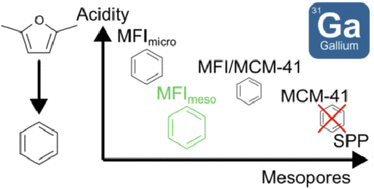
Zeolitic catalysts used in the industrial manufacture of commodity chemicals excel thanks to their thermal stability, chemical tunability, and microporosity, aiding catalytic functions and shape- and size-selectivity that can be utilised also in reactions such as the conversion of biomass-derived furans into green aromatics, i.e., benzene, toluene, and xylenes (BTX). However, excessive aromatization into polyaromatics and other carbonaceous species results in blocking of both active sites and micropores, ultimately deactivating the catalyst. As a solution, here, three classes of microporous materials comprising complementary meso- and/or macroporous domains have been synthesised and explored for the conversion of 2,5-dimethylfuran to BTX. First, meso- and macropores have been introduced in microporous Ga-MFI zeotype catalysts, with varying gallium content, via post-synthesis template-assisted base leaching. This increases the catalytic activity per acid site thanks to enhanced mass transfer properties, although at the expense of the acid site density, ultimately leading to similar overall production of aromatics. Second, gallium doped mesoporous silica, Ga-MCM-41, is shown to decrease the selectivity towards monoaromatics while increasing the formation of coke, due to the mere presence of mesopores. Through a one-pot, two-temperature step hydrothermal synthesis, Ga-MFI/MCM-41 composites were formed by partial transformation of the Ga-MCM-41 mesopore walls into microporous MFI-framework domains. Thereby, the selectivity towards benzene and isomerisation products increases while that for coke decreases. Third, Ga-containing self-pillared pentasil units (SPP) have been synthesised with varying gallium content. These materials possess both microporous MFI-domains and a broad size range of meso- and macropores in between said domains. However, due to its low acidity, almost no conversion of 2,5-dimethylfuran into benzene is observed. By comparing these three classes of materials, the critical role of the micropores is highlighted, as well as a potentially beneficial role of meso- and macropores. Moreover, the acid site density, generated by gallium, plays an important promoting role to convert 2,5-dimethylfuran into aromatics. Only when the majority of the material consists of microporous MFI, the selectivity is towards monocyclic aromatics such as benzene, instead of polycyclic aromatics and other coke species.
- This article is part of the themed collection: Advances in Sustainable Catalysis: from Materials to Energy and Environmental Applications
 Please wait while we load your content...


