


 PLATFORM UPDATE:


Al2O3-assisted hierarchical Ni–Al surface alloying for scalable fabrication of nano-roughened Ni foam cathodes with superior HER activity and durability in alkaline water electrolysis

Abstract
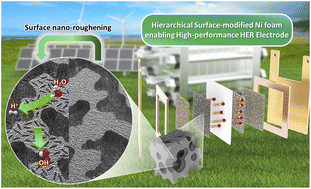
Plate-type electrodes in zero-gap alkaline water electrolysers often suffer from severe gas-bubble accumulation and sluggish mass transport, which diminish the effective electrochemically active surface area (ECSA) and retard hydrogen evolution reaction (HER) kinetics. Herein, we report an Al2O3-assisted surface-modification strategy that converts Ni foam into a hierarchically structured, catalyst-free HER cathode with markedly enhanced activity and durability in concentrated alkaline media. During thermal alloying, Al2O3 nanoparticles act as morphological regulators that promote the formation of finely dispersed Ni–Al phases while suppressing Ni coarsening, thereby stabilizing the evolving surface structure. Subsequent alkaline leaching generates a dual-scale porous architecture comprising microscale pores and secondary nanoscale roughness. The resulting electrode (m-NF_A) exhibits a tenfold increase in double-layer capacitance (Cdl = 104.2 mF cm−2) relative to pristine Ni foam, indicating a substantially enlarged accessible surface area. In 30 wt% KOH half-cell tests, m-NF_A delivers an overpotential of 157.8 mV at 100 mA cm−2 and a Tafel slope of 69 mV dec−1, signifying facilitated water dissociation kinetics. Notably, the hierarchical surface shows superhydrophilicity with a near-zero water contact angle, which alleviates bubble pinning and promotes rapid gas detachment under high-rate operation. When implemented as the cathode in a zero-gap alkaline water electrolysis single cell (80 °C, Zirfon PERL 220), m-NF_A demonstrates stable load-following behaviour and durability over 1000 load cycles (200–1000 A cm−2, 66 h), reaching cell voltages of 1.72 and 2.00 V at 200 and 1000 mA cm−2 at 1000 cycles. Collectively, this Al2O3-mediated modification strategy provides a scalable and cost-effective pathway to high-performance, non-noble metal HER electrodes for renewable-energy-driven alkaline electrolysis.
- This article is part of the themed collections: Journal of Materials Chemistry A HOT Papers and Advances in Sustainable Catalysis: from Materials to Energy and Environmental Applications
 Please wait while we load your content...


