


 PLATFORM UPDATE:


Interface-engineered melt-spun BiSbTe for multiscale phonon scattering and enhanced thermoelectric performance

Abstract
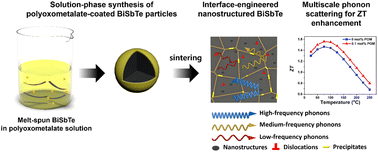
Thermoelectric materials have attracted tremendous attention owing to their ability to directly convert heat into electricity. Enhancing the thermoelectric efficiency of materials relies on minimizing thermal conductivity via phonon scattering engineering, where the broad spectrum of phonon frequencies requires multiscale architectures capable of scattering phonons over diverse wavelengths. In this study, we developed BiSbTe-based thermoelectric materials featuring multiscale hierarchical microstructures, achieved via melt-spinning synthesis of nanostructured BiSbTe particles followed by solution-phase coating with polyoxometalates (POMs). During spark plasma sintering, the POM surface layers decompose to form ultrathin oxide interfacial layers within the BiSbTe grains. These oxide interfaces, in combination with nanoscale features, effectively suppress lattice thermal conductivity to 0.38 W m−1 K−1 at room temperature with only 0.1 mol% POM additive, yielding a peak figure of merit (ZT) of 1.56 at 75 °C. This work demonstrates a scalable strategy for realizing multiscale phonon scattering and enhanced thermoelectric performance through interface engineering.
- This article is part of the themed collection: Thermoelectric energy conversion
 Please wait while we load your content...


