


 PLATFORM UPDATE:


Nanoscale thermal transport at PbTe grain boundaries: a neural-network-potential molecular dynamics study

Abstract
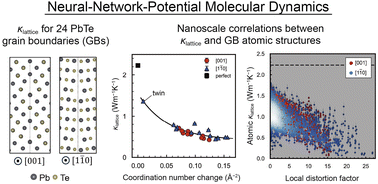
Grain boundaries (GBs) are nano- and mesoscale defects that play a key role in tailoring lattice thermal conductivity κl and enhancing thermoelectric conversion efficiency. However, even in the prototypical thermoelectric material PbTe, the relationship between GB atomic structure and lattice thermal transport remains poorly understood. Here, we combine a neural-network potential (NNP) with perturbed molecular dynamics to determine κl in the directions normal and parallel to the GB planes for 24 symmetric tilt GBs in PbTe. The NNP accurately reproduces GB energetics and finite-temperature atomic forces, enabling large-scale simulations of GB models containing thousands of atoms. Along the GB-normal direction, κl shows a tendency to decrease with coordination-number change, and the corresponding GB thermal resistances vary by a factor of seven depending on the GB structure. Along the GB-parallel directions, κl is influenced by bond-length distortion and the crystallographic orientation of grains, and the effect of GBs extends over a spatial range of about 10 nm from the GB planes. These results suggest that thermal transport parallel to GB planes is also non-negligible, particularly for nanocrystalline samples. Atom-resolved thermal conductivities exhibit only weak correlations with local structural descriptors, highlighting the necessity of macroscopic descriptors that encode the GB network and its relation to the direction of heat flux. These findings provide fundamental insights into GB-dependent phonon transport in PbTe and offer a basis for data-driven GB engineering and microstructure design to further improve thermoelectric performance.
- This article is part of the themed collection: Thermoelectric energy conversion
 Please wait while we load your content...


