


 PLATFORM UPDATE:


Selective amphiphilic polyelectrolyte complex bilayers with sub-nanometer effective pore sizes and high permeance
 a
Ayse
Asatekin
*a
a
Ayse
Asatekin
*a
Abstract
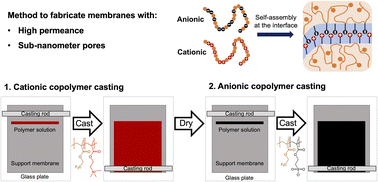
As membrane applications expand, there is a need for new and improved membrane materials whose selectivity can be tuned to achieve complex separations while maintaining high permeance. This is particularly important for molecular and ion separations, where effective pore sizes must be ∼1 nm. This study describes a new family of membranes with self-assembling polymer selective layers formed by a simple, scalable manufacturing process. Amphiphilic polyelectrolyte complex (APEC) bilayer membranes are prepared by coating consecutive layers of two amphiphilic polyelectrolytes (APEs). These APEs are water-insoluble copolymers combining a hydrophobic monomer (e.g. trifluoroethyl methacrylate) with either an anionic monomer (e.g. sulfopropyl methacrylate) or a cationic monomer (e.g. trimethylaminoethyl methacrylate). APEC membranes exhibit much smaller effective pore sizes than obtained from either APE as a selective layer, arising from interactions between oppositely charged polymer chains. These initial APEC bilayer membranes exhibit high organics rejection and low molecular weight cut-off (MWCO) values with extremely high permeances when compared with commercial nanofiltration and reverse osmosis membranes. For instance, some APEC bilayer membranes exhibit permeances of 20 L m−2 h−1 bar−1 with MWCOs below 350 Da. The effective pore size and salt selectivity of APEC membranes can be tuned by changing the charged monomer chemistry and the hydrophobic/charged monomer ratios. This demonstrates a versatile and highly customizable approach for developing high-performance membranes for the separation of salts and small molecules (100–2000 Da).
 Please wait while we load your content...


