


 PLATFORM UPDATE:


Micro-macro synergistic regulation of the Co–N–C bond and dielectric-magnetic-dielectric sandwich structure for promoting broadband microwave absorption
 ab
ab
Abstract
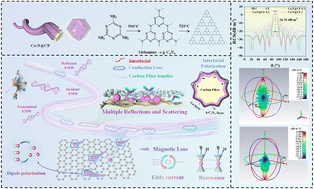
Tuning the dielectric loss and impedance matching of carbon fibers (CFs) through heteroatom doping and microstructural design is an effective strategy for enhancing their electromagnetic wave absorption (EWA) performance. Herein, a Co-centered metal–organic framework (MOF) was constructed via coordination chemistry to achieve uniform growth on industrial carbon fiber (CF), and then, Co/N@CF nanomaterials for the loss of electromagnetic waves with dielectric-magnetic synergy were successfully prepared by pyrolysis. The introduction of melamine to achieve N-atom doping to form Co–N–C bonds through pyrolysis and helped construct a dielectric-magnetic-dielectric interlayer structure derived from g-C3N4-Co-CF nanocomposites, resulting in a large number of defect-induced and interfacial polarization.Moreover, a multilayer heterogeneous structure prolongs the transmission paths of electromagnetic waves, enhancing their multiple reflections and scatterings. Based on multiplex microwave dissipation mechanisms, the Co/N@CF nanocomposite shows electromagnetic absorption (EMA) performance. When the filling ratio is merely 5 wt%, the optimized Co/N@CF-0.2 nanocomposite achieves a minimum reflection loss (RLmin) of −41.28 dB at a matching thickness of 2.1 mm and an effective absorption bandwidth (EAB) of 7.02 GHz at 2.3 mm, covering the X-band and Ku-band. CST Studio Suite simulations show that the radar cross-section (RCS) value of a perfect electric conductor (PEC) plate coated with the Co/N@CF-0.2 nanocomposite is significantly lower than that of a pure PEC plate. When the incident angle of an electromagnetic wave is θ = 90°, the RCS reduction is as high as 24.76 dB m2. Apparently, this work confirms that heteroatom doping and dielectric-magnetic-dielectric structure design are beneficial for achieving broadband absorption and broadening the field of electromagnetic stealth research.
 Please wait while we load your content...


