


 PLATFORM UPDATE:


Precursor degree of polymerization engineering to understand the sodium storage behavior of closed pores in hard carbon
 *ab
*ab
Abstract
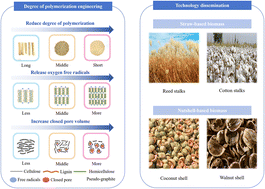
Closed pores are critical structures in biomass-based hard carbon, especially in terms of volume and pore size. However, existing strategies for regulating closed pore structures are limited, primarily relying on the use of chemical agents to remove lignin and hemicellulose, which reduces carbon yield and poses environmental pollution risks. This study proposes a precursor degree of polymerization strategy to modulate the volume and pore size of closed pores in hard carbon. It has been observed that reducing the polymerization degree of the precursor disrupts the rigid and compact lignified structure, releases oxygen free radicals, lowers the pyrolysis energy barrier, and promotes more complete pyrolysis. The release of oxygen free radicals yields hard carbon with smaller pore sizes and larger closed pore volumes, significantly improving the sodium storage performance. After regulating the degree of polymerization of the precursor, the closed pore volume of the derived hard carbon increased from 0.043 cm3 g−1 to 0.197 cm3 g−1, while the reversible specific capacity at a current density of 30 mA g−1 increased from 293.64 mAh g−1 to 327.06 mAh g−1, with a particularly notable 37.79 mAh g−1 enhancement in the plateau capacity. Ex situ SAXS and TEM testing indicate that HC-PP-300 shows a high reversibility of Na+ during the discharge and charge processes. This strategy was successfully applied to straw-based and nutshell-based biomass precursors, demonstrating its universality. This work provides a new approach for developing biomass-based hard carbon with a high closed pore volume and high plateau capacity.
 Please wait while we load your content...


