


 PLATFORM UPDATE:


Cottonseed cake-derived hard carbon anode with modulated carbon layer spacing and pores for highly reversible and durable sodium-ion batteries

Abstract
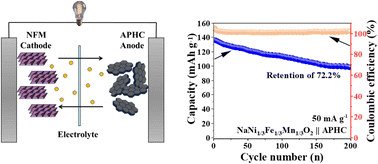
Biomass-derived hard carbon, as a type of highly promising anode material for sodium-ion batteries (SIBs), has garnered considerable interest owing to its merits of various sources, diverse structural features, desirable surface chemistry and low cost. However, its practical utilization has been hindered by bottlenecks, including an unreasonable synthesis process and unclear elucidation between the Na-storage mechanism and specific microstructures. Herein, a novel cottonseed cake-derived hard carbon anode material was synthesized using a combined approach of pre-oxidization, acid–base treatment and carbonization. This approach effectively expands the carbon interlayer spacing and enables the formation of appealing pores for hard carbon, promoting the achievement of high-performance Na storage in SIBs. Consequently, the optimized APHC sample delivers an impressive initial reversible capacity of 302.1 mAh g−1, a high initial coulombic efficiency of 92.3%, and a remarkable capacity retention rate of 95.8% over 200 cycles at 100 mA g−1. Moreover, the assembled full cell with commercial NaNi1/3Fe1/3Mn1/3O2 as the cathode material displays a high reversible capacity of 136.1 mAh g−1, retaining 72.2% of its initial capacity after 200 cycles at 50 mA g−1. This work provides a facile strategy for the design of advanced cottonseed cake-derived hard carbon anode materials with modulated carbon layer spacing and pores for rechargeable SIBs.
- This article is part of the themed collections: Journal of Materials Chemistry A HOT Papers and Journal of Materials Chemistry A Emerging Investigators 2026
 Please wait while we load your content...


