


 PLATFORM UPDATE:


Correlating Li+ jump pathways and vibrational properties in lithium aluminum germanium phosphate glasses

Abstract
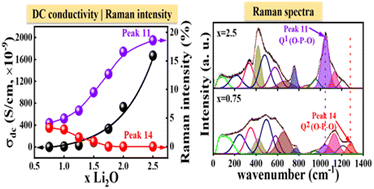
Lithium aluminum germanium phosphate (LAGP) glass ceramics have attracted considerable attention as promising solid electrolytes for next-generation lithium batteries owing to their improved safety and thermal stability. Despite significant progress, fundamental questions regarding Li+ hopping processes, effective charge carrier concentration, and carrier mobility in glassy systems remain unresolved. In this work, we investigate the fundamental relationship between fast lithium-ion transport and the network structure in xLi2O–0.25Al2O3–1.5GeO2–1.5P2O5 (xLi2O-AGPO; 0.75 ≤ x ≤ 2.5) glasses. The dc conductivity increases by nearly three orders of magnitude, from 1.73 × 10⁻⁹ S cm−1 (x = 0.75) to 1.67 × 10⁻⁶ S cm−1 (x = 2.5) at 50 °C, while the dc activation energy decreases with increasing Li2O content. The effective charge carrier concentration is evaluated from the conductivity data, and the corresponding carrier mobility is estimated. The charge carrier concentration increases nearly proportionally with Li2O content, whereas the carrier mobility exhibits an exponential increase, similar to the trend observed for the dc conductivity. These results indicate that the exponential enhancement of dc conductivity with increasing x is primarily governed by the increase in carrier mobility. The facile migration of Li+ is attributed to fractal conduction pathways formed by non-bridging oxygen sites, which are generated through the depolymerization of the phosphate network.
 Please wait while we load your content...


