


 PLATFORM UPDATE:


Rational design of multivariate covalent organic frameworks with enhanced light-harvesting for selective detection and photocatalytic reduction of Cr(vi)

Abstract
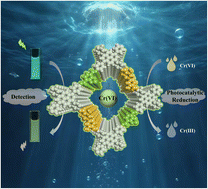
The effective monitoring and selective removal of hexavalent chromium (Cr(VI)) are critical for aquatic environmental remediation and human health protection. Herein, a series of binary and ternary covalent organic frameworks (COFs) containing donor–acceptor linkages or hydroxyl nanotraps were synthesized via a molecular engineering strategy for simultaneous detection, selective adsorption, and photocatalytic reduction of Cr(VI). The optimized ternary COF (BTD-OH-COF) outperformed binary COFs containing only adsorptive or photocatalytic groups, exhibiting enhanced fluorescence properties, a rapid response to Cr(VI), and a limit of detection of 68 nmol L−1. Moreover, with its dual adsorption and photocatalytic functionalities, the BTD-OH-COF achieves a Cr(VI) removal efficiency of 99.9% under simulated sunlight irradiation without the use of sacrificial agents. Its removal efficiency was approximately 1.50 times higher than those of binary COFs, respectively. Theoretical and experimental results confirm that constructing hydroxyl adsorption sites with donor–acceptor photoactive units synergistically enhances adsorption capacity while significantly reducing the energy gaps, thereby facilitating electron–hole separation and boosting photocatalytic activity. This study provides novel design principles for bifunctional monitoring/photocatalytic materials and offers an innovative approach for remediating heavy metal pollution in water.
- This article is part of the themed collection: Journal of Materials Chemistry A HOT Papers
 Please wait while we load your content...


