


 PLATFORM UPDATE:


Computational screening of piezoelectric constants in metal–organic frameworks: design principles and ferroelectric-like bond modulation

Abstract
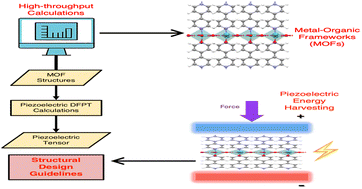
Piezoelectric energy harvesting is a process in which energy in the form of kinetic movements can be harvested and converted into useful electrical energy using piezoelectric materials. Metal–organic frameworks (MOFs) have a huge potential for piezoelectric energy harvesting owing to their high flexibility, structural tunability, and very low dielectric constants due to their high porosity. The piezoelectric constant d relevant for piezoelectric energy harvesting depends on the piezoelectric constant e and the flexibility of the structure (i.e. mechanical properties). The mechanical properties of MOFs have previously been extensively studied but the piezoelectric constant e was never explored for MOFs. In this work, we generate a database of piezoelectric properties, specifically e for around ∼1608 previously synthesized non-centrosymmetric MOF structures. The calculations were performed using the density functional perturbation theory (DFPT) method. The highest piezoelectric constant e obtained in this work is approximately ∼2.76 C m−2, which is significantly higher than that of the flexible organic piezoelectric polymer polyvinylidene fluoride (PVDF) and its copolymers. In this work, we analyze and identify structural factors that influence the values of the piezoelectric constant for high-performing MOFs. Based on that, a series of guidelines for the design of MOF structures that can lead to a high piezoelectric constant e are presented. One class of high-performing piezoelectric MOFs is based on polar patterns of O—(short)—Mo—(long)—O unequal bond length, reminiscent of ferroelectric inorganic oxides. This class could have potential for ferroelectricity, meaning that the bond length pattern could be reversed by external electrical field. We substantiate this by showing experimentally via SHG-microscopy that the O—(short)—Mo—(long)—O unequal bond lengths are indeed malleable by external conditions.
 Please wait while we load your content...


