


 PLATFORM UPDATE:


Tuning surface redox chemistry through trace Ni doping in cobalt pyrophosphate (Co2P2O7) for high-performance supercapacitors: experimental and theoretical insights
 *ab
*ab
Abstract
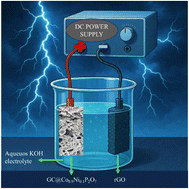
The electrochemical performance of cobalt pyrophosphate (Co2P2O7) as a supercapacitor electrode can be markedly improved by trace nickel doping. The optimized Ni-doped Co2P2O7 (Ni : Co = 0.1 stoichiometric ratio) electrode exhibits an impressive specific capacitance of 490.2 F g−1 at 1.5 A g−1, significantly surpassing that of pristine Co2P2O7, reflecting enhanced charge-storage capability. To elucidate the underlying mechanism, in situ Raman spectroscopy and X-ray photoelectron spectroscopy (XPS) depth profiling were employed, revealing that the formation of surface Co3+ species promotes reversible redox transitions and accelerates ionic diffusion. However, excessive Ni doping (beyond the 0.2 stoichiometric ratio) disrupts this balance, leading to diminished capacitance. These combined experimental and theoretical insights demonstrate that minimal Ni doping effectively tunes the surface chemistry and electronic structure of Co2P2O7, thereby enabling superior pseudocapacitive behaviour. Furthermore, an assembled asymmetric supercapacitor device delivered a high energy density of 26.23 W h kg−1 and a power density of 1859.22 W kg−1, underscoring the material's potential for high-performance energy storage applications.
- This article is part of the themed collection: Supercapacitors for a sustainable energy future
 Please wait while we load your content...


