


 PLATFORM UPDATE:

Unveiling the irreversible structural evolution upon rehydration of manganese-based Prussian white: an in situ X-ray diffraction study

Abstract
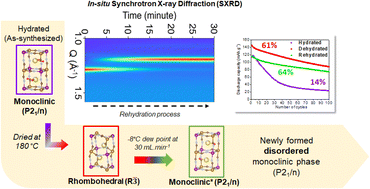
Manganese-based Prussian White (PW) Na2−xMn[Fe(CN)6]y·□1−y·zH2O (0 ≤ x ≤ 2, 0 ≤ y ≤ 1) is a promising cathode material for sodium-ion batteries, due to the variety of its composition, its intercalation properties, and its good electrochemical performance. However, water-induced structural transformations limit its practical application and remain poorly understood. To unravel how water content governs structure transformations in relation to electrochemical performance, a rehydration of a heat-treated Na1.67Mn[Fe(CN)6]0.88·□0.12 compound was monitored by in situ synchrotron X-ray diffraction performed under a controlled atmosphere. At a dew point of −8 °C and a flow rate of 30 mL min−1, the original rhombohedral (dehydrated) phase transforms in 20 minutes into a newly formed disordered monoclinic structure. Water uptake induces a significant expansion of the lattice volume and enhanced structural disorder. Regarding the electrochemical performance, a promising first discharge capacity of 145 mAh g−1 is obtained for the dehydrated PW, corresponding to 85% of its theoretical capacity (∼170 mAh g−1). Surprisingly, the rehydrated compound demonstrates a rather high capacity retention of 64%, while the hydrated compound retains only 14% of its initial capacity over 100 cycles at a C/10 rate in a voltage range of 2.5–4 V vs. Na+/Na. This study provides new quantitative insights into the impact of humidity exposure on PW and on its structural integrity after a heat treatment. The present work will help implement cost-effective PW cathode materials in practice.
 Please wait while we load your content...


