


 PLATFORM UPDATE:


Deuterium-induced hydrogen bond strengthening: a novel strategy for high stability in hybrid perovskites
 *be
*be
Abstract
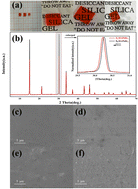
Organic–inorganic hybrid perovskites exhibit outstanding properties, including long carrier diffusion lengths, strong visible light absorption, and high extinction coefficients. In these materials, organic cations (MA+) play a critical role in the development of perovskite devices. However, the inherent thermal instability and moisture sensitivity of organic cations are the core reasons leading to material degradation and decreased device stability, which greatly limit the practical application of organic–inorganic hybrid perovskites. To enhance the stability of perovskites, inspired by the stronger hydrogen bonds in heavy water, we replaced the methylammonium cation (CH3NH3+, MA+) in the perovskite with its deuterated form, CH3ND3+, anticipating that this would strengthen the hydrogen bonding with the inorganic framework, thereby effectively improving the material's structural stability and device lifetime. We found that this molecular-level reinforcement leads to multi-faceted macroscopic performance improvements. Firstly, it increases the initial decomposition temperature of the perovskite. This enhancement in thermal stability directly translates into the reliable operation capability of perovskite devices under harsher environmental conditions. Secondly, the stronger hydrogen bond network effectively suppresses the formation of hydrogen vacancies, thereby reducing non-radiative recombination losses. The enhanced hydrogen bonding strengthens the lattice structure, significantly improving the stability of the perovskite material in ambient air.
 Please wait while we load your content...


