Graph neural network-based multi-objective Bayesian optimization for enhanced screening of metal–organic frameworks with optimal separation performance

Abstract

Metal–organic frameworks (MOFs) are porous crystalline materials with applications in gas capture, drug delivery, and molecular separations. While high-throughput computational screening has traditionally identified promising MOFs, recent advances increasingly harness machine learning to accelerate discovery and screening. Existing optimization methods such as Bayesian optimization (BO) and genetic algorithms often overlook the detailed structure–property relationships critical to MOF performance. Here, we present an optimization workflow that couples graph neural networks (GNNs) with multi-objective BO to enhance MOF discovery and screening. By representing MOFs as graphs embedding atomic- and structural-level features, GNNs capture intricate structure–property correlations, enabling more accurate property predictions than traditional methods relying solely on macroscopic descriptors. Our integrated framework efficiently identifies Pareto-optimal MOF candidates tailored for improved separation of alkanes, alkenes, alcohols, and aromatics, demonstrating the significant advantage of graph-based models in materials optimization workflows.
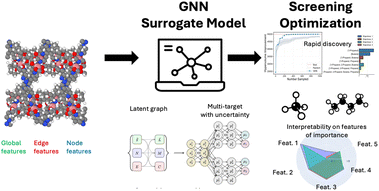
Graphical abstract: Graph neural network-based multi-objective Bayesian optimization for enhanced screening of metal–organic frameworks with optimal separation performance

Supplementary files

Transparent peer review

To support increased transparency, we offer authors the option to publish the peer review history alongside their article.

View this article’s peer review history

Article information

Article type
Paper
Submitted
10 Nov 2025
Accepted
18 Jan 2026
First published
09 Feb 2026
This article is Open Access
Creative Commons BY-NC license

J. Mater. Chem. A, 2026, Advance Article

Graph neural network-based multi-objective Bayesian optimization for enhanced screening of metal–organic frameworks with optimal separation performance

L. E. Schultz, N. Gantzler, N. S. Bobbitt, D. F. Sava Gallis and R. Dingreville, J. Mater. Chem. A, 2026, Advance Article , DOI: 10.1039/D5TA09133K

This article is licensed under a Creative Commons Attribution-NonCommercial 3.0 Unported Licence. You can use material from this article in other publications, without requesting further permission from the RSC, provided that the correct acknowledgement is given and it is not used for commercial purposes.

To request permission to reproduce material from this article in a commercial publication, please go to the Copyright Clearance Center request page.

If you are an author contributing to an RSC publication, you do not need to request permission provided correct acknowledgement is given.

If you are the author of this article, you do not need to request permission to reproduce figures and diagrams provided correct acknowledgement is given. If you want to reproduce the whole article in a third-party commercial publication (excluding your thesis/dissertation for which permission is not required) please go to the Copyright Clearance Center request page.

Read more about how to correctly acknowledge RSC content.

Social activity

Spotlight

Advertisements