


 PLATFORM UPDATE:


Understanding the spin effects of single-atom alloys on the electrocatalytic nitrogen reduction reaction
 *a
*a
Abstract
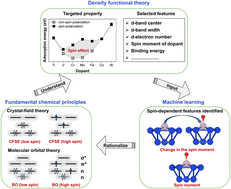
Spin, as an inherent part of the electronic structure, plays a critical role in determining catalyst properties and performance. To reveal spin effects on adsorption and reaction behaviors of catalysts, we constructed a set of models for single-atom alloys (SAAs) using the {111} facets of Ni, Co and Cu (face-centered cubic crystals) as host metals, in which the doped metals have similar chemical environments and exhibit distinct spin-dependent electronic structures. Machine learning models were trained using adsorption energy data obtained from density functional theory (DFT) calculations, and the resulting spin-dependent features were then interpreted through the lens of fundamental chemical principles to elucidate their physicochemical significance. Spin moments of dopants can cause antibonding orbitals formed between dopants and adsorbates to become prematurely occupied by spin electrons, thus reducing the bond orders and weakening the bonding interactions. Changes in spin moments of dopants before and after adsorption alter the magnetic coupling strengths between the dopant and host metals, analogous to changes in the stabilization energy of dopants in the 9-coordination quasi-crystal-field environment. These understandings can be used to explain the W-shaped trend in adsorption energy of the fourth-period SAAs. Quite inspirationally, this study essentially clarifies the spin effects of SAAs in terms of catalytic processes by a combination of cutting-edge machine learning methods and fundamental chemical principles.
- This article is part of the themed collection: Journal of Materials Chemistry A HOT Papers
 Please wait while we load your content...


