


 PLATFORM UPDATE:


Regulating manganese dioxide polymorphism by epitaxial electrodeposition for reversible aqueous Zn metal batteries

Abstract
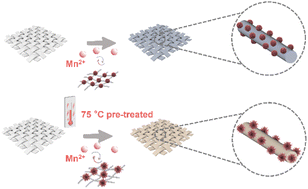
The practical deployment of high-energy Mn2+/MnO2 deposition chemistry in aqueous zinc metal batteries is fundamentally challenged by sluggish reaction kinetics due to the low electron conductivity of the deposited MnO2. Herein, we report a direct epitaxial growth strategy to bypass this kinetic and thermodynamic limitation, enabling the stable electrodeposition of thermodynamically favored, highly conductive γ-MnO2 at ambient temperature. This is achieved through the pre-deposition of γ-MnO2 seed layers at elevated temperatures, which enable the phase-selective growth of subsequent MnO2via a coherent homoepitaxial interface. The resulting epitaxial electrode exhibits high conductivity, reduced structural symmetry, weakened Mn–O interaction, and a well-defined nanorod architecture, collectively contributing to accelerated reaction kinetics. The Zn‖γ-MnO2 cells demonstrate promising electrochemical performance with high rate capability (86.2% at 30 mA cm−2), high areal capacity (20 mAh cm−2), and prolonged cyclability (>3000 cycles). This work underscores interfacial phase design as a pivotal strategy for regulating polymorphic electrodeposition in advanced batteries.
- This article is part of the themed collections: Journal of Materials Chemistry A HOT Papers and Advanced aqueous batteries
 Please wait while we load your content...


