


 PLATFORM UPDATE:


Donor-site-acceptor dual-modulation covalent organic frameworks for synergistic U(vi) photoreduction and immobilization
 *ab
and
*ab
and
Abstract
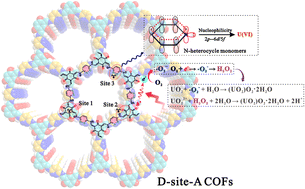
The efficient recovery of uranium (U(VI)) from seawater is crucial for sustainable development and the circular economy. Photocatalytic reduction of U(VI) has garnered significant attention for its efficiency and sustainability. However, the mismatch in timescales between photogenerated carrier transport and surface catalytic reactions further exacerbates the recombination of photogenerated carriers. To enhance the photoreduction efficiency of U(VI), it is necessary not only to increase the carrier transport rate within the bulk phase but also to augment the number of active sites to harmonize bulk migration with charge transport at the interface. In this work, we constructed a series of donor-site-acceptor (D-site-A) β-ketoenamine covalent organic frameworks (COFs-TpPa-Nx) by controlling the number (x = 0, 1, 2, 3) and positions (para-, meta-, ortho-) of N atoms via N-heterocycle modification. The findings revealed that the introduction of N-heterocycles effectively regulated the electronic structure of COFs while suppressing photogenerated carrier recombination, whereas the excess N atoms paradoxically became recombination centers for electron–hole pairs. Among these COFs, TpPa-N2-m exhibited the most favorable photocatalytic U(VI) reduction performance, achieving a removal rate of 94.4%. Besides, the photocatalytic reaction rate order of TpPa-Nx obtained by fitting the pseudo-first-order kinetic model was: TpPa-N2-m (0.922 h−1) > TpPa-N2-p (0.6 h−1) > TpPa-N2-o (0.387 h−1) > TpPa-N1 (0.253 h−1) > TpTt (N = 3, 0.199 h−1) > TpPa-1 (N = 0, 0.164 h−1), indicating that the meta-N-doped TpPa-N2 exhibited 5.6-fold higher photocatalytic activity compared to TpPa-1. Meanwhile, TpPa-N2-m was prepared as an agar-floating catalyst for U(VI) fixation in actual seawater. After five consecutive days of reaction, the U(VI) adsorption capacity reached 25.8 mg g−1, exceeding the U(VI) adsorption standard (6.0 mg g−1). The mechanism analysis of photocatalytic performance improvement indicated that the introduction of N-heterocycles achieved multiple effects: increasing the number of active sites, promoting U(VI) adsorption, enhancing electron–hole separation, and facilitating efficient O2 activation to promote H2O2 generation, thereby promoting the immobilization of U(VI) on the catalyst surface in the form of (UO2)O2·2H2O. This work provided insights for designing photocatalysts based on multi-scale structures from the electronic-atomic-molecular levels, and offered guidance for the practical application efficiency of U(VI) extraction from seawater.
 Please wait while we load your content...


