


 PLATFORM UPDATE:


Analysing a Pd metallosurfactant derived single atom catalyst for biofouling mitigation and the oxygen reduction reaction in microbial fuel cells
 *b
and
Gurpreet
Kaur
*a
*b
and
Gurpreet
Kaur
*a
Abstract
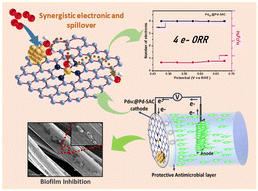
Cathode biofouling remains a major challenge to the efficiency and long-term stability of membrane-less single-chamber microbial fuel cells (SCMFCs). Herein, we report the synthesis of a Pd single-atom and ultrasmall Pd nanocluster-decorated N-doped mesoporous carbon (PdNC@Pd-SAC) catalyst via a wet impregnation-assisted pyrolysis-deposition route. The PdDDAB metallosurfactant acted as a single-source precursor for Pd, N, and C, while amine-functionalized mesoporous silica nanoparticles (MSiNs) served as a structural template to direct the formation of a stable palladium-anchored mesoporous carbon framework. During high-temperature pyrolysis, the decomposition of PdDDAB generated volatile intermediates that transformed into carbon residues confined within the silica meso-channels, facilitated by the synergistic interaction of the amphiphilic surfactant moiety and Pd active centers forming micellar assemblies. Morphological analysis revealed the co-existence of atomically dispersed Pd sites and ultrasmall Pd nanoclusters. The synergistic electronic and spillover effects of these dual active sites significantly enhanced the four-electron ORR pathway while mitigating cathode biofouling. PdNC@Pd-SAC achieved a half-wave potential of 0.82 V vs. RHE and a diffusion-limited current density of 4.82 mA cm−2, comparable to the values of Pt/C, along with superior durability and resistance to Pd agglomeration. In SCMFCs, it delivered 582 mW m−2 power density, i.e., 1700 percent higher than that of bare CC, and maintains stable output voltage over one month operation. PdNC@Pd-SAC directly interacts with bacterial cell membrane, penetrates intracellularly, disrupts membrane integrity, causes cellular content release, and effectively prevents cathode biofouling.
- This article is part of the themed collection: Journal of Materials Chemistry A HOT Papers
 Please wait while we load your content...


