


 PLATFORM UPDATE:


Flow-regime-controlled mass transfer intensification for fabricating superior silicon–carbon anode materials
 *ab
*ab
Abstract
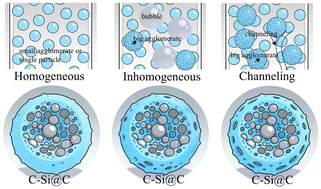
The fluidization dynamics of ultrafine powders are demonstrated to be critically governed by their stirring sequence (stirring-first versus stirring-last modes), which presets initial particle distribution and agglomerate morphology. Experiments with ultrafine TiO2 powder reveal that a uniform fluidized state is uniquely induced by the stirring-last mode, in contrast to the non-ideal bubbling regimes promoted by stirring-first. Through the construction of a flow regime map based on high-speed imaging and pressure measurements, coupled with a force-balance model (quantified by the flow number, Co, and Froude number, Fr), a critical criterion is identified: effective agglomerate breakup and homogeneous fluidization occur only when collision forces exceed interparticle adhesion (Co > 1). This mechanism is shown to be universally applicable across TiO2, SiO2 and Al2O3 powders. Furthermore, particulate fluidization is found to enhance gas–solid mass transfer significantly, exhibiting a volumetric mass transfer coefficient that is several times higher and sustained longer than other regimes. Implemented in a fluidized-bed CVD process for silicon–carbon anodes, this strategy yields C-Si@C composites with highly uniform coatings, which deliver a high specific capacity (>1750 mA h g−1), initial Coulombic efficiency of ∼83%, and exceptional capacity retention over 400 cycles. This work establishes flow-regime engineering as a potent strategy for advancing high-performance battery materials.
- This article is part of the themed collection: Journal of Materials Chemistry A HOT Papers
 Please wait while we load your content...


