


 PLATFORM UPDATE:


The hidden cost of solvent exchange: how mechanical damage compromises Ti3C2Tx MXene nanosheet properties
 *a
Rochelle P.
Ibabao,
a
Kim Marie D.
Sisican,
a
Mia
Judicpa,
a
Rufus Mart
Ceasar R. Ramos,
a
Jizhen
Zhang,
ac
Elmer S.
Austria, Jr,
d
Behnam
Akhavan,
def
Anupma
Thakur,
g
Nithin
Chandran B. S.,
g
Luke C.
Henderson,
a
Babak
Anasori
gh
and
Joselito M.
Razal
*ai
*a
Rochelle P.
Ibabao,
a
Kim Marie D.
Sisican,
a
Mia
Judicpa,
a
Rufus Mart
Ceasar R. Ramos,
a
Jizhen
Zhang,
ac
Elmer S.
Austria, Jr,
d
Behnam
Akhavan,
def
Anupma
Thakur,
g
Nithin
Chandran B. S.,
g
Luke C.
Henderson,
a
Babak
Anasori
gh
and
Joselito M.
Razal
*ai
Abstract
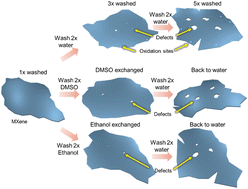
Ti3C2Tx MXene nanosheets (hereafter “MXene”) demonstrate great potential for applications in wearable electronics, sensors, energy storage, biomedical devices, and electromagnetic interference shielding. Their richly functionalized surfaces enable redispersion from water into polar organic solvents, offering flexibility for processing using non-aqueous inks. However, this solvent exchange process, typically achieved through vigorous vortex mixing, reduces the electrical conductivity of the resulting material. While this decrease has been attributed to increased interlayer spacing due to solvent intercalation, we show that mechanical agitation during solvent exchange directly causes sheet damage. Our results indicate that different redispersion conditions produce MXene sheets with varying degrees of damage and oxidation, which in turn lead to decreased conductivity. This drop persists even with volatile solvents and after annealing up to 200 °C. Furthermore, reversing the process by exchanging the organic solvent back to water, thereby restoring the interlayer spacing, still yields lower conductivity than pristine MXene. Collectively, these results indicate that mechanical sheet degradation is irreversible. We anticipate that recognizing the critical role of processing-induced damage will guide researchers in developing optimized MXene processing conditions to achieve desired material properties for specific applications.
 Please wait while we load your content...


