


 PLATFORM UPDATE:


Off-stoichiometry-driven electronic structure modulation leads to high thermoelectric performance in n-type InSb: an experimental study with theoretical insights
 a
Manojkumar
Moorthy,
c
Subhradeep
Chatterjee,
g
V.
Kanchana
*b
and
Suresh
Perumal
*a
a
Manojkumar
Moorthy,
c
Subhradeep
Chatterjee,
g
V.
Kanchana
*b
and
Suresh
Perumal
*a
Abstract
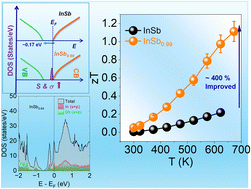
The off-stoichiometry strategy, achieved through defect engineering, has recently garnered significant attention for enabling high thermoelectric (TE) performance through electronic and phonon structure modulations. Here, we demonstrate high TE performance in an off-stoichiometric InSb, obtained via electronic structure modulation, by Sb-vacancies-assisted resonant-like defect states formation around the Fermi level, EF, and reduction in the thermal conductivity by point-defects-driven phonon scattering. Interestingly, Sb-vacancies significantly increase the electron carrier concentration and facilitate a sharp defect states near EF, resulting in (i) an increase in the electrical conductivity, (ii) an enhanced Seebeck coefficient and (iii) a reduction in the optical bandgap. Furthermore, point-defect-driven phonon scattering notably reduces the lattice thermal conductivity to ∼1.42 W m−1 K−1 and overall, a maximum TE figure of merit, zT, of ∼1.1 at 673 K, about 400% higher than pristine InSb (∼0.22), was achieved for a composition of InSb0.99 and exhibits a significantly high hardness of ∼3.6 GPa. Additionally, a maximum theoretical conversion efficiency of ∼7.7% is predicted for a temperature gradient of ∼400 K, using a counter material of p-type ZnSb, making InSb as a promising material for intermediate-temperature TE applications. This work demonstrates a novel dopant-free defect-engineering approach for obtaining high-performance TE materials.
- This article is part of the themed collection: Journal of Materials Chemistry A HOT Papers
 Please wait while we load your content...


