


 PLATFORM UPDATE:


Passive multistage solar desalination enables durable high-efficiency freshwater production
 a
and
Yahua
Liu
*ac
a
and
Yahua
Liu
*ac
Abstract
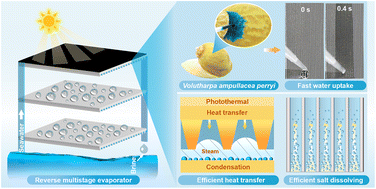
Solar desalination presents a sustainable solution to global water scarcity, with reverse multistage distillation systems offering particularly high efficiency. The hydrophilic wick, serving as the evaporation interface in reverse multistage distillation systems, is an essential component. However, conventional hydrophilic layers suffer from low thermal conductivity and salt accumulation, which undermine long-term efficiency and operational stability. Here, we report a Volutharpa ampullacea perryi-inspired interface, featuring an aluminum-based superhydrophilic surface integrated with glass fiber conduits. This architecture enables rapid, directional transport of micron-scale liquid films, suppressing localized salt crystallization while reducing evaporation heat transfer due to the low thermal conductivity of glass fibers. Under one sun illumination, the system achieves a record solar-to-steam efficiency of 410% and a freshwater production rate of 6.25 kg m−2 h−1 and meanwhile retains stable operation without salt accumulation over extended periods. These results establish a new paradigm for solar desalination with scalable, efficient, and salt-resistant freshwater collection for global water-stressed regions.
- This article is part of the themed collection: Journal of Materials Chemistry A HOT Papers
 Please wait while we load your content...


