Synergistic redox enhancement in ternary Mn–ZnFeOOH oxyhydroxides for high-performance supercapacitor applications

Abstract

High-performance electrode materials are vital for developing next-generation supercapacitors with enhanced energy storage capability. Mixed metal oxyhydroxides can exhibit better performance due to their high pseudo-capacitance and tunable redox activity. Thus, introducing another metal led to an enhancement of their electrochemical performance through synergistic effects and the creation of new redox-active sites. Here, Mn was incorporated into ZnFeOOH (FZ) to develop a ternary oxyhydroxide, which demonstrates the effect of Mn (FZMn-0 to FZMn-20) on the structural and electrochemical properties. Among them, FZMn-15 exhibited the most favorable characteristics, achieving a high specific capacitance of 1531 F g−1 at 1 A g−1 in a three-electrode system, while the corresponding asymmetric FZMn-15‖AC device delivered 92 F g−1. Furthermore, charge storage analysis indicated a diffusion-dominated process with additional capacitive contributions, highlighting the combined effect of Mn incorporation on electrochemical activity. These findings demonstrate that Mn-modified ZnFeOOH electrodes can serve as efficient and reliable materials for advanced supercapacitor applications.
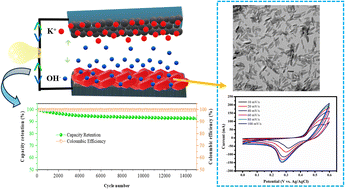
Graphical abstract: Synergistic redox enhancement in ternary Mn–ZnFeOOH oxyhydroxides for high-performance supercapacitor applications

Supplementary files

Article information

Article type
Paper
Submitted
05 Nov 2025
Accepted
20 Mar 2026
First published
30 Mar 2026
This article is Open Access
Creative Commons BY-NC license

J. Mater. Chem. A, 2026, Advance Article

Synergistic redox enhancement in ternary Mn–ZnFeOOH oxyhydroxides for high-performance supercapacitor applications

P. Rajkumar, V. Thirumal, N. M. Chidambaram, M. S. Iyer, M. Prasanna, I. Park, S. Kim, K. Yoo and J. Kim, J. Mater. Chem. A, 2026, Advance Article , DOI: 10.1039/D5TA08979D

This article is licensed under a Creative Commons Attribution-NonCommercial 3.0 Unported Licence. You can use material from this article in other publications, without requesting further permission from the RSC, provided that the correct acknowledgement is given and it is not used for commercial purposes.

To request permission to reproduce material from this article in a commercial publication, please go to the Copyright Clearance Center request page.

If you are an author contributing to an RSC publication, you do not need to request permission provided correct acknowledgement is given.

If you are the author of this article, you do not need to request permission to reproduce figures and diagrams provided correct acknowledgement is given. If you want to reproduce the whole article in a third-party commercial publication (excluding your thesis/dissertation for which permission is not required) please go to the Copyright Clearance Center request page.

Read more about how to correctly acknowledge RSC content.

Social activity

Spotlight

Advertisements