


 PLATFORM UPDATE:


Rapid lithium extraction via solar-thermal interfacial evaporation with zero liquid discharge
 *a
Chunlei
Guo
*a
*a
Chunlei
Guo
*a
Abstract
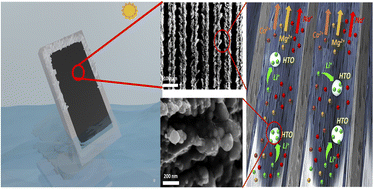
The global lithium demand has surged by over 150% in the past three years, intensifying the need for sustainable extraction methods beyond traditional ore mining. Extraction from salt-lake brines offers an abundant alternative, yet existing processes are slow, energy-intensive, and environmentally damaging. Here, we introduce an energy-efficient and self-sustaining solar-thermal interfacial evaporator with simultaneous extraction of lithium (STEEL) without brine discharge by integrating lithium-ion sieve technology. STEEL is made of a multifunctional superwicking black metal (SWBM) panel that pulls a thin water film uphill across its surface and absorbs nearly all solar radiation for interfacial evaporation. To enable on-site selective lithium-ion extraction, we have embedded hydrogen titanate (HTO) nanoparticles (NPs) in the SWBM microcapillaries. HTO NPs selectively extract lithium ions via H+ ↔ Li+ ion exchange, while effectively rejecting other competing ions. Additionally, STEEL achieves surface self-cleaning even when treating Mg2+-containing saltwater, which is unattainable by most solar evaporators. STEEL demonstrates stable performance under 1 sun illumination, achieving an average evaporation rate of 1.04 ± 0.01 kg m−2 h−1, a salt harvesting rate of 106.01 ± 2.09 g m−2 h−1, and a lithium mining rate of 0.21 ± 0.02 g m−2 day−1, corresponding to nearly 100% total mineral recovery and 50% lithium extraction efficiency. The resulting eluate from Great Salt Lake water exhibits a significant increase in the cation mass composition of lithium, rising from 0.09% in the salt-lake water to 70.12%, making it an ideal feedstock for subsequent refining. This self-powered and zero-waste approach offers a scalable pathway for sustainable lithium production from natural brine.
 Please wait while we load your content...


