


 PLATFORM UPDATE:


A novel bipolar phthalocyanine-based composite cathode for advanced Zn-organic batteries
 *a
*a
Abstract
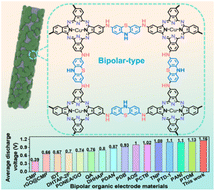
Redox-active conjugated microporous polymers (CMPs) combine the advantages of environmental benignity and tunable molecular architectures, offering great potential for advanced zinc-organic batteries (ZOBs). However, their intrinsic low electrical conductivity often results in suboptimal utilization of active sites and consequently, limited specific capacity. Here, a composite material—CuPc-DPTZ-CMPs/CNT composite—was successfully synthesized via a facile solvothermal approach using (tetraamino-phthalocyaninato)copper(II) (CuPc(NH2)4), 3,7-dibromo-10H-phenothiazine (DPTZ), and carbon nanotubes (CNTs). By integrating n-type C![[double bond, length as m-dash]](https://www.rsc.org/images/entities/char_e001.gif) N and p-type -S- and –NH– redox-active centers within a bipolar CuPc-DPTZ CMP framework and leveraging the high electrical conductivity of CNTs, the resulting composite enables efficient multielectron redox reactions. When employed as a cathode in ZOBs, the CuPc-DPTZ-CMPs/CNT composite delivers exceptional electrochemical performance. The assembled Zn//CuPc-DPTZ-CMPs/CNT composite battery achieves a high specific capacity of 155 mAh g−1 at a current density of 0.4 A g−1, with an average discharge voltage of 1.16 V, surpassing the performance of all previously reported bipolar ZOBs. Moreover, the battery exhibits excellent cycling stability, retaining 85% of its initial capacity after 5000 cycles at a high current density of 10 A g−1. This work broadens the chemical scope of multi-electron redox-active bipolar organic materials, advancing their application in state-of-the-art ZOBs.
N and p-type -S- and –NH– redox-active centers within a bipolar CuPc-DPTZ CMP framework and leveraging the high electrical conductivity of CNTs, the resulting composite enables efficient multielectron redox reactions. When employed as a cathode in ZOBs, the CuPc-DPTZ-CMPs/CNT composite delivers exceptional electrochemical performance. The assembled Zn//CuPc-DPTZ-CMPs/CNT composite battery achieves a high specific capacity of 155 mAh g−1 at a current density of 0.4 A g−1, with an average discharge voltage of 1.16 V, surpassing the performance of all previously reported bipolar ZOBs. Moreover, the battery exhibits excellent cycling stability, retaining 85% of its initial capacity after 5000 cycles at a high current density of 10 A g−1. This work broadens the chemical scope of multi-electron redox-active bipolar organic materials, advancing their application in state-of-the-art ZOBs.
 Please wait while we load your content...


