


Unravelling lone pair induced bonding effects on thermal conductivity in metal chalcogenides using machine learning potentials

Abstract
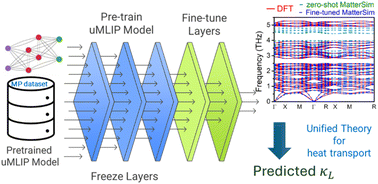
Chemical bonding plays a critical role in phonon dynamics and lattice thermal conductivity (κL), essential for designing materials with intrinsically low κL. Pnictogen chalcogenides (pn–chg) are attractive candidates due to bonding asymmetry caused by stereochemically active lone pairs (SCALPs), which arise from asymmetric ns-np hybridization. However, since not all pn–chg compounds exhibit low κL, it is essential to explore additional bonding-related factors beyond SCALP. To address this and overcome the computational cost of high-throughput screening, we present a scalable transferable framework based on a fine-tuned MatterSim model for efficient prediction of κL using the Wigner formulation of heat transport. Furthermore, benchmarking and validating with existing MACE, CHGNet and MatterSim uMLIPs predicted κL with high-fidelity predicted κL. We introduce bonding descriptors that quantify two key contributors to κL, namely the SCALP effect, which accounts for approximately 40 percent, and additional bonding and geometric distortions, which contribute around 60 percent. These findings highlight the dominant role of structural factors beyond SCALP in suppressing κL. This work demonstrates that the fine-tuned universal MatterSim model serves as a robust and scalable framework for predicting thermal transport. By incorporating advanced bonding descriptors, it enables the accelerated discovery of low- κL materials for thermoelectric applications.
 Please wait while we load your content...


