


 PLATFORM UPDATE:


Cyclic olefin copolymer-based reinforced anion exchange membranes for water electrolyzers

Abstract
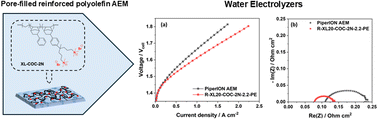
Anion exchange membranes (AEMs) have emerged as a promising technology for water electrolysis in hydrogen production since they offer significant cost reduction in choices of electrocatalysts and bipolar plates. However, AEMs satisfying multiple requirements of high ionic conductivity, good chemical stability, robust mechanical properties, scalable synthesis, and low manufacturing costs are rare. Herein, we introduce quaternary ammonium functionalized cyclic olefin copolymers (COCs) as a new class of chemically stable and low-cost AEM materials. To further enhance the mechanical robustness, we prepared reinforced composite AEMs by impregnating the ionically functionalized COC into a mechanically robust matrix. The resulting reinforced composite membrane exhibits a high hydroxide conductivity of 127 mS cm−1 and excellent mechanical strength. In water electrolyzers, the MEA demonstrated outstanding performance, achieving a current density of 2.24 A cm−2 at 1.8 V, attributable to high conductivity, enhanced mechanical properties, and good alkaline stability of the composite membrane. These results indicate that the COC-based AEMs demonstrate good potential for application in AEM electrolyzers.
- This article is part of the themed collection: Journal of Materials Chemistry A HOT Papers
 Please wait while we load your content...


