


 PLATFORM UPDATE:


Electrocatalytic hydrogen generation from seawater: advances, opportunities, challenges and future roadmap
 *ab
*ab
Abstract
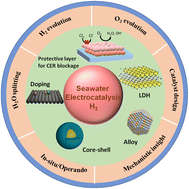
Electrochemical hydrogen production from seawater offers a promising pathway toward large-scale green hydrogen generation while alleviating dependence on freshwater resources. However, the practical deployment of seawater electrolysis remains fundamentally challenged by chloride-induced corrosion, parasitic chlorine evolution, inorganic scaling, sluggish reaction kinetics, and long-term instability of catalysts, membranes, and electrolyzer components. This review presents a mechanistically grounded and system-integrated perspective on seawater electrolysis by explicitly linking reaction thermodynamics and kinetics with interfacial chemistry, materials design, and electrolyzer-level operation. We first outline the fundamental hydrogen and oxygen evolution reaction pathways in acidic and alkaline environments, emphasizing the origins of competing chlorine chemistry, surface degradation, and cathodic fouling unique to saline electrolytes. Recent advances in electrocatalyst engineering including layered double hydroxides, alloys, core–shell structures, metal oxides/hydroxides, and heterostructured systems are critically assessed. Emphasis is placed on strategies that regulate local reaction environments, suggesting reduced chloride adsorption while promoting dynamic surface reconstruction and self-healing behavior. Particular attention is given to anion-regulated interfaces, protective structures and localized pH modulation as unifying design principles for enhancing selectivity and durability. Beyond catalyst development, this review integrates electrolyzer-level considerations by comparing alkaline, proton-exchange-membrane, and anion-exchange-membrane configurations and by evaluating direct versus indirect seawater electrolysis from a technology-readiness perspective. Insights from in situ/operando characterization and density functional theory are highlighted as essential tools for correlating atomic-scale descriptors with macroscopic performance. Collectively, this review provides a transferable, mechanism-to-system roadmap for the rational development of selective, durable, and scalable seawater electrolysis technologies.
- This article is part of the themed collection: Journal of Materials Chemistry A Recent Review Articles
 Please wait while we load your content...


