


 PLATFORM UPDATE:


Effect of preconditioning on cycling performance of aqueous Zn-ion batteries

Abstract
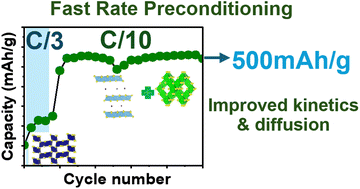
In this study, we provide valuable insights into the preconditioning effects on optimization of a zinc ion (Zn–MnO2) battery with lower current rates. While other academic papers aim to provide fundamental insights and highly engineered approaches, this paper aims to provide a commercially relevant study that improves the performance of a full system that can be applied at scale. We demonstrate that fast C-rate preconditioning effectively improves the performance of Zn–MnO2 full cells when used in synergy with an aqueous electrolyte with 1 vol% acetonitrile additive and optimized ZnSO4 and MnSO4 salt concentrations. Three cycles of preconditioning protocols using C/3 rate and 1C rate led to a remarkable specific discharge capacity of over 500 mAh g−1 for low loading cathodes of ∼2 mg cm−2 after 25 cycles at C/10 rate. Discharge capacity ∼350 mAh g−1 and high coulombic efficiency of 99% can be maintained even after increasing electrode loadings to commercially relevant levels of ∼6 mg cm−2. These results demonstrate that preconditioning could activate internal restructuring of the electrolytic MnO2 cathode during fast-rate cycling and can lead to the creation of more efficient pathways for both electrons and ions, improving the overall conductivity and Zn2+ transport. It highlights electrochemical preconditioning as a simple yet powerful strategy to achieve high specific discharge capacities in commercial aqueous zinc-ion batteries.
- This article is part of the themed collections: Celebrating International Women’s Day 2026: Women in Journal of Materials Chemistry A and Advanced aqueous batteries
 Please wait while we load your content...


