


 PLATFORM UPDATE:


Tailored charge distribution modulated by cyclic carbonates enabling the development of high-performance PEO-based solid electrolytes
 *b
and
*b
and
Abstract
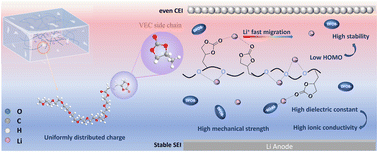
Polyethylene oxide (PEO) is widely used in solid electrolytes because of its excellent interface compatibility and film-forming ability. However, its low room-temperature ionic conductivity and narrow electrochemical window limit its commercial application. Herein, these issues can be effectively addressed via a carbonate-tuned strategy based on different cyclic carbonate side chains such as vinylene carbonate (VC) and vinylethylene carbonate (VEC). By shielding lithium salt electrostatic interactions through ion–dipole interactions, the highly polar carbonyl group of VEC preferentially induces the decomposition of DFOB−, forming a composite SEI film rich in LiF and thus inhibiting the continuous decomposition of PEO. It is noted that PEVEC SPE exhibits superior electrochemical performance due to flexible chain segment movement and uniform charge regulation. The optimized SPE presents a high ionic conductivity of 3.87 × 10⁻⁵ S cm−1 at 25 °C and a broad electrochemical window of 4.9 V. Besides, the Li/Li symmetric cell displays excellent cycle stability over 2500 hours. Notably, the Li/LFP cell shows enhanced long-term stability (capacity retention is 93.73% after 1000 cycles at 25 °C). More importantly, the 4.4 V Li/LCO battery displays a capacity retention rate of 84.4% after 120 cycles at 25 °C. Meanwhile, this well-engineered electrolyte enables outstanding safety performance in pouch cells even under harsh deformation and sectioning conditions. This carbonate-tuned strategy opens new avenues for designing PEO-based solid electrolytes towards high-performance lithium metal batteries.
 Please wait while we load your content...


