


Slow-light enhanced photocatalytic water splitting over Cu-incorporated 3D ordered macroporous ZIF-8
 *a
and
Yating
Wang
*ab
*a
and
Yating
Wang
*ab
Abstract
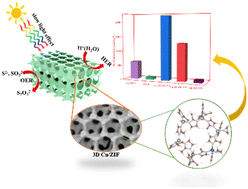
To address the urgent demand for efficient solar-to-hydrogen conversion, a novel Cu-doped 3D ordered macroporous (3DOM) ZIF-8 photocatalyst was fabricated via polystyrene sphere templating coupled with a dual-solvent method. Systematic characterization confirmed the preservation of the ZIF-8 crystalline structure after ∼2 at% Cu2+ incorporation. The 3DOM framework amplified light absorption via slow-light effects, while Cu2+ doping narrowed the band gap and further intensified the slow-light phenomenon. The optimized Cu-3D-ZIF-325 exhibited a photocatalytic hydrogen evolution rate of 2233.2 µmol g−1 h−1, which is 29 times higher than that of pristine ZIF-8. This performance enhancement originated from synergistic mechanisms: EIS measurements revealed that Cu2+ sites improved charge separation, and the optimized band structure facilitated carrier transport; DFT calculations further verified that Cu2+ optimized the adsorption/dissociation of water and elevated the conduction band potential, strengthening the reductive driving force for H2 production. This work establishes a viable dual-modification strategy for high-efficiency MOF-based photocatalysts.
- This article is part of the themed collection: Journal of Materials Chemistry A HOT Papers
 Please wait while we load your content...


