


 PLATFORM UPDATE:


Orbital hybridization-induced direct Z-scheme in CuCoO2/MoX2 heterostructures for overcoming kinetic imbalance in overall water splitting
 *a
Jian
Yang
a
*a
Jian
Yang
a
Abstract
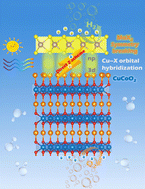
Delafossite CuCoO2 demonstrates considerable potential as a p-type photocatalytic material for the oxygen evolution reaction, though its practical implementation in overall water splitting faces challenges due to pronounced kinetic imbalance between hydrogen and oxygen evolution pathways and limited operational stability. This computational study explores a series of mixed-dimensional heterostructures formed by combining CuCoO2 with MoX2 (X = O, S, Se, Te) monolayers using first-principles calculations. The investigated heterostructures exhibit stable interfaces with hybrid chemical–van der Waals characteristics, among which CuCoO2/MoTe2 shows the most substantial binding energy of −0.2056 eV Å−2. Electron localization function and Mulliken charge analysis provide clear evidence of significant interfacial Cu–X orbital hybridization, effectively facilitating charge transfer across the interface and mitigating the spatial blocking effect commonly observed in conventional van der Waals heterostructures. The formation of the heterointerface additionally induces symmetry breaking within the MoX2 layer, generating a built-in electric field that further promotes charge carrier separation. Electronic structure analysis confirms the establishment of a direct Z-scheme charge transfer mechanism, which spatially separates hydrogen evolution active sites on MoX2 from oxygen evolution sites on CuCoO2. From the systematic screening of chalcogen elements, CuCoO2/MoO2 and CuCoO2/MoTe2 emerge as particularly promising candidates, demonstrating low hydrogen evolution reaction barriers (0.85 eV and 1.54 eV, respectively) and appreciable solar-to-hydrogen conversion efficiencies (4.45% and 6.11%). Beyond identifying specific material combinations, this work establishes fundamental principles for designing high-performance mixed-dimensional photocatalytic systems through targeted interface orbital hybridization.
 Please wait while we load your content...


