


 PLATFORM UPDATE:


The mechanism of Li-ion transport in carbonate-based electrolytes
 a
and
Tianying
Yan
*a
a
and
Tianying
Yan
*a
Abstract
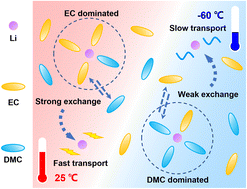
Molecular dynamics (MD) simulations were performed on a carbonate-based electrolyte, composed of 1 M lithium hexafluorophosphate (LiPF6) dissolved in the mixture of ethylene carbonate (EC) and dimethyl carbonate (DMC) (1 : 1 v/v), at temperatures of 298.15 K, 273.15 K, 253.15 K, 233.15 K, and 213.15 K, respectively. The simulations revealed that as temperature decreases, the contribution of DMC to the first solvation shell of Li+ increases significantly, leading to the formation of more DMC-rich solvation structures. Meanwhile, Li+ increasingly tends to form solvent-separated ion pair (SSIP) with PF6−. These dynamically sluggish solvation structures hinder Li+ transport in the electrolyte. Further analysis shows that a low-temperature suppresses solvent exchange and weakens the structural transport. These findings elucidate how temperature-induced changes in solvation structures and transport mechanisms jointly hinder Li+ transport, providing molecular-level insights for the rational design of next-generation electrolytes and for enhancing the low-temperature performance of lithium-ion batteries.
- This article is part of the themed collection: Journal of Materials Chemistry A HOT Papers
 Please wait while we load your content...


