


 PLATFORM UPDATE:


Activating interfacial polarization via snowflake-sphere dual-vacancy heterostructures for efficient S-scheme photocatalytic hydrogen evolution

Abstract
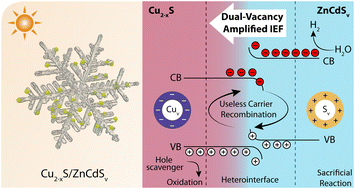
Photocatalytic water splitting represents a promising avenue for sustainable hydrogen production. However, conventional catalysts such as Cu2−xS are plagued by rapid charge recombination and sluggish surface kinetics. While constructing heterojunctions can enhance charge separation, this strategy often entails a compromise between efficient charge transfer and high redox potential. Defect engineering introduces vacancy sites that enhance active surfaces and local polarization, but single vacancies yield limited field strength. To address these challenges, we designed a dual-vacancy synergistic polarization strategy. This approach enabled the successful construction of a hierarchical Cu2−xS/ZnCdS S-scheme heterojunction, composed of snowflake-like Cu2−xS and spherical ZnCdS. The synergistic vacancies generate a strong interfacial polarization field that couples with the built-in electric field, thereby greatly enhancing directional carrier separation and transfer while retaining robust redox potentials. Owing to this rational design, the optimized 5 wt% Cu2−xS/ZnCdS photocatalyst delivers a remarkable hydrogen evolution rate of 18.2 mmol g−1 h−1 under visible light and exhibits excellent stability. Comprehensive characterization and calculations reveal that the interfacial dipole moment reaches 317.2 debye, 7–10 times higher than that of pristine components, evidencing the strong polarization effect induced by dual vacancies. Moreover, electron paramagnetic resonance spectroscopy detects superoxide and hydroxyl radicals even under dark conditions, directly confirming a non-photonic charge transfer process. This work establishes a defect-mediated polarization mechanism via dual-vacancy engineering, effectively overcoming the inherent limitations of conventional heterojunctions and single-vacancy systems.
 Please wait while we load your content...


