


Enhanced photocatalytic hydrogen peroxide production over g-C3N4/MoS2 composites through phase-interface engineering: electron transfer and synergy mechanism

Abstract
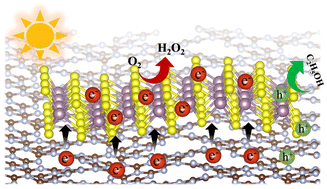
Photocatalytic synthesis of hydrogen peroxide (H2O2) from water and oxygen offers a green and sustainable alternative to the energy-intensive anthraquinone process. Noble metal-free MoS2 is a promising photocatalyst, yet its performance is limited by the high H2O2 decomposition activity of its thermodynamically stable 2H-phase. Herein, we overcome this intrinsic bottleneck by synergistically engineering the phase composition and interfacial charge dynamics within a g-C3N4/MoS2 heterostructure, achieving over a two-order-of-magnitude enhancement compared to pure MoS2, and ∼2-fold higher yield for 1T-rich g-C3N4/MoS2 than 1T-low g-C3N4/MoS2. This remarkable performance originates from a dual-pronged strategy. First, increasing the 1T-phase content in MoS2 favorably modulates the conduction band level, establishing the thermodynamic driving force for H2O2 production. Concurrently, this phase modulation aligns the Fermi level of MoS2 with g-C3N4, minimizing the interfacial energy barrier and promoting electron transfer from g-C3N4 to MoS2, a pathway directly visualized by in situ X-ray photoelectron spectroscopy and Kelvin probe force microscopy. The g-C3N4 further contributes by enhancing light harvesting and providing a high surface area. Our work illustrates that the deliberate and synergistic manipulation of phase and interface engineering provides a powerful design paradigm for overcoming inherent catalytic limitations, paving the way for the rational development of high-efficiency MoS2-based photocatalysts for solar-to-chemical energy conversion.
 Please wait while we load your content...


