


 PLATFORM UPDATE:


Entropy-mediated lattice strain in a Ruddlesden–Popper perovskite oxide for highly active and bifunctional oxygen electrocatalysis

Abstract
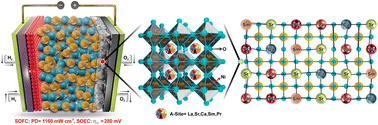
High entropy perovskite oxides (HEPOs) possess transformative potential for electrochemical energy devices by facilitating unprecedented tunability in structure and functionality. Herein, we report the development of a conventional La2NiO4+δ (LNO) cathode and a novel A-site high entropy (La0.2Ca0.2Sr0.2Sm0.2Pr0.2)2NiO4+δ (HELNO) cathode as a highly active, bifunctional oxygen electrocatalyst for solid oxide fuel/electrolysis cells (SOFCs/SOECs). Systematic substitution of five equimolar cations at the A-site induces severe lattice distortion, thereby stabilizing and facilitating the mobility of oxygen defects, which synergistically enhance the oxygen reduction and evolution kinetics. In SOFC mode, the HELNO cathode achieves exceptional peak power densities of 1160, 939, 739, 509, and 310 mW cm−2 at temperatures of 650, 600, 550, 500, and 450 °C, respectively. For the OER in electrolysis, HELNO exhibits a low overpotential of 280 mV at 10 mA cm−2 and a reduced Tafel slope (88.4 mV dec−1), significantly outperforming LNO. Combined spectroscopic and electrochemical analyses confirm that entropy-driven lattice strain optimizes Ni valence states (Ni3+/Ni2+), enriches stable surface-active oxygen species, and accelerates ion diffusion. This study establishes high entropy Ruddlesden–Popper perovskites as a paradigm for next-generation bifunctional electrodes, illustrating the significant influence of entropy engineering on electrocatalytic activity and stability.
 Please wait while we load your content...


