


 PLATFORM UPDATE:


Phosphorus–nitrogen dual-doping engineering in hard carbon microspheres for enhanced sodium-ion storage
 *ac
Lei
Wang
*ac
and
*ac
Lei
Wang
*ac
and
Abstract
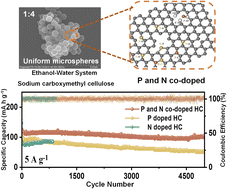
Resin-derived hard carbon (HC) is widely applied as an anode material in SIBs, owing to its high purity and facile processability. However, the practical utilization of HC remains restricted by its unsatisfactory cycling stability together with poor rate performance, even though various heteroatom doping strategies have been employed to address these issues. Herein, a dual-heteroatom doping strategy is presented to synthesize resin microspheres via a modified Stöber method, followed by one-step carbonization to obtain phosphorus (P) and nitrogen (N) co-doped hard carbon (PNHC). The uniform incorporation of P and N effectively modulates the carbon electronic structure. Specifically, p doping promotes pyridinic-N formation, simultaneously increasing the interlayer distance and generating structural defects. Consequently, the PNHC anode exhibits a reversible capacity of 317 mA h g−1 after 100 cycles at 0.1 A g−1. Even under a high current density of 5 A g−1, it delivers 112.5 mA h g−1 after 5000 cycles, representing 91% capacity retention with respect to the initial value (123.6 mA h g−1), indicating its superior rate performance and long-term cycling stability. Our strategy provides a rational dual-heteroatom doping strategy and offers design principles for high-performance HC anodes applied in SIBs.
- This article is part of the themed collection: Journal of Materials Chemistry A HOT Papers
 Please wait while we load your content...


