


 PLATFORM UPDATE:


Flexible energy: energy harvesting and storage with liquid metals

Abstract
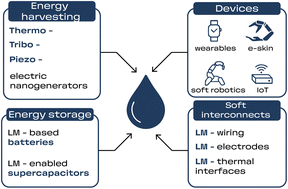
The rapid development of flexible electronics and soft robotics challenges a simultaneous (r)evolution in power sources, demanding energy solutions that are equally stretchable and mechanically compliant. Without such advances, the practical potential of these technologies remains limited. Liquid metals have emerged as a key material class to address this challenge, offering an unmatched combination of intrinsic fluidity, high electrical conductivity, and deformability. This review comprehensively examines the role of liquid metals as active components in next-generation energy systems. We discuss in detail their integration into flexible energy harvesters, including thermoelectric generators, triboelectric nanogenerators, and piezoelectric systems, as well as advanced storage devices such as batteries and supercapacitors. Moving beyond discrete components, the review underscores the critical area of integrated energy systems, surveying current strategies for developing multifunctional platforms that combine energy harvesting and storage on a single, deformable substrate. Synthesizing global research efforts, we also address the key challenges hindering commercialization, such as maintaining stable interfaces under cyclic deformation, ensuring environmental sustainability, and achieving scalable manufacturing. Finally, the review outlines promising future research directions. Our goal is for this work to serve as a roadmap for researchers in materials science and energy engineering, highlighting the interdisciplinary collaboration required to fully unlock the potential of liquid metals for powering the autonomous electronics of the future.
- This article is part of the themed collection: Journal of Materials Chemistry A Recent Review Articles
 Please wait while we load your content...


