


 PLATFORM UPDATE:


Aqueous PVP-to-HOC conversion enables the fabrication of binder/current-collector free flexible LMO cathodes with high energy
 *a
*a
Abstract
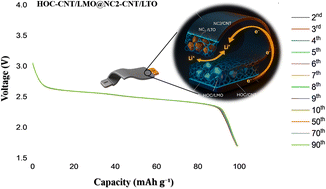
Aqueous processing that is both binder- and current-collector free is an attractive route toward practical flexible cathodes. However, maintaining intimate and durable contact between micron-scale LiMn2O4 (LMO) particles and carbon scaffolds remains challenging at low processing temperatures. Here, we use poly(vinylpyrrolidone) (PVP) as a dual-role additive that (i) disperses CNTs and µm-scale LMO uniformly in water and (ii) converts in situ at 300 °C (inert) into a conformal hybrid-organic carbon (HOC) interlayer that “glues” particles to the sp2 network. Temperature screening (200–450 °C) identifies ∼300 °C as an effective low-T window compatible with free-standing flexibility and LMO stability. In half-cells, the HOC-enabled film (HOC–CNT/LMO) delivers 121.0/120.8 mAh g−1 with 99.9% CE at the 100th cycle, outperforming a PVP-only control (P–CNT/LMO, 99.8/98.6 mAh g−1, 99.9% CE). The device attains a full cell-level specific energy of 195 Wh kg−1 at the 100th cycle, approximately twice that of the singly modified full cell and over an order of magnitude higher than that of the conventional LMO/Al@LTO/Cu configuration. Density functional theory links the interfacial gains to a smaller gap for the graphene–HOC interface (2.54 eV vs. 3.56 eV), π-delocalized frontier orbitals, and broader non-covalent dispersion, consistent with stronger electronic coupling to CNTs. Collectively, the PVP → HOC route provides an all-aqueous, low-temperature strategy to engineer conformal interlayers that stabilize LMO interfaces and enable the preparation of robust, flexible, high-performance CNT/LMO cathodes without NMP, polymer binders, or metal current collectors.
 Please wait while we load your content...


