


 PLATFORM UPDATE:


Influence of precursor type on NMC811 cathode material properties: insights from spray pyrolysis synthesis and in situ XRD analysis
 *ab
Farheen
Sayed,
c
Clare P.
Grey,
c
Kai
Luo,
d
Simone
Hochgreb,
a
Michael
De Volder
a
and
Adam
Boies
*ae
*ab
Farheen
Sayed,
c
Clare P.
Grey,
c
Kai
Luo,
d
Simone
Hochgreb,
a
Michael
De Volder
a
and
Adam
Boies
*ae
Abstract
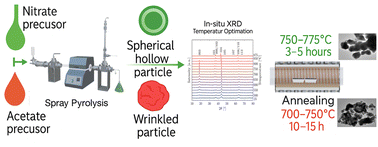
Lithium nickel manganese cobalt oxide (NMC811) has emerged as a promising cathode material for next-generation lithium-ion batteries. This study presents a comprehensive investigation of NMC811 synthesis via single-step spray pyrolysis using nitrate and acetate precursors. We systematically examine the influence of precursor chemistry on particle properties through XRD, Raman spectroscopy, TGA, and electron microscopy. As-synthesized particles exhibit rock-salt NiO-like phases, with precursor-dependent morphologies: nitrate yields controlled micron-scale spherical agglomerates (1–6 µm) of primary particles while acetate produces folded structures of similar scale (1–6 µm). In-situ heated XRD reveals distinct structural evolution pathways, identifying optimal annealing windows of 750–775 °C (nitrate) and 700–750 °C (acetate) in oxygen atmosphere for layered oxide formation. Nitrate-derived particles achieve well-ordered structures within 3–5 hours, while acetate-derived materials require 10–15 hours to attain comparable cation ordering. Electrochemical evaluation demonstrates comparable performance between precursor systems, with discharge capacities of 187 mAh per g (nitrate) and 183 mAh per g (acetate), and stability over 20 cycles. These findings establish spray pyrolysis as a viable single-step route for NMC811 production and provide crucial processing guidelines for scaled synthesis.
 Please wait while we load your content...


