


 PLATFORM UPDATE:


Customizing phase separation in non-fullerene-based organic photovoltaics: the impact of interfacial morphology

Abstract
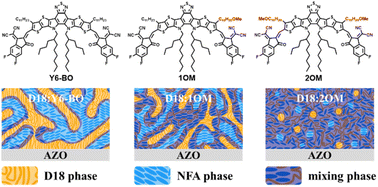
Organic photovoltaics (OPVs) have shown continuous rapid improvements in power conversion efficiency (PCE) to date owing to newly developed materials and their functionalization. Nevertheless, precise morphological control in the active layer remains challenging. In particular, manipulating the degree of phase separation appears as a key avenue to reduce geminate charge recombination. Herein, we report a strategy to tailor the mixing/pure phase in OPVs via terminal engineering of the non-fullerene acceptor materials. We selectively design asymmetric (1OM) and symmetric (2OM) derivatives of Y6-BO. Our further analysis shows a stepwise-tailored degree of phase separation in the active layer when pairing the above three acceptors with D18 as the donor. Interestingly, 1OM not only suppressed the excessive crystallization and domain growth of D18 but also facilitated the formation of a well-balanced phase-separated morphology (Y6-BO > 1OM > 2OM) with continuous donor and acceptor domains. These results in 1OM-based OPV with a PCE value of 19.1%, higher than that of Y6-BO (17.5%) and 2OM (18.2%), with additionally reduced geminate charge recombination revealed by ultra-fast transient absorption spectroscopy. We believe our findings highlight the importance of interfacial compatibility and morphology control in achieving efficient OPV cells.
 Please wait while we load your content...


