


 PLATFORM UPDATE:

Beyond the 2/3 approximation: a multiscale evaluation of the FRET orientation factor in nonfullerene acceptors
 *a
Rafael B.
Ribeiro,
b
Guilherme
Carneiro Queiroz da Silva,
c
João Paulo A.
Souza,
d
Márcio T. do N.
Varella,
b
Graziâni
Candiotto,
a
Marlus
Koehler
e
and
Marcos G.
Menezes
a
*a
Rafael B.
Ribeiro,
b
Guilherme
Carneiro Queiroz da Silva,
c
João Paulo A.
Souza,
d
Márcio T. do N.
Varella,
b
Graziâni
Candiotto,
a
Marlus
Koehler
e
and
Marcos G.
Menezes
a
Abstract
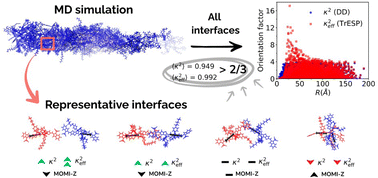
Fluorescence resonance energy transfer (FRET) plays a key role in exciton migration within organic optoelectronic devices, with the orientation factor (κ2) being one of its most critical yet poorly characterized parameters. Conventional approaches often assume statistical κ2 values (e.g., 2/3 or 0.476), which may lead to inaccurate estimates of Förster radii, transfer rates, and exciton diffusion lengths. In this work, we introduce a novel multiscale computational strategy that combines molecular dynamics simulations and density functional theory to evaluate κ2 for two widely used nonfullerene acceptors, IT-4F and Y6. Coulombic interactions were calculated using the transition charges from the electrostatic potentials (TrESP) method and compared with the dipole–dipole (DD) approximation, revealing that the latter produces large errors at shorter intermolecular distances (<20 Å). The calculated κ2 distributions exhibit a broad dispersion, with mean values significantly higher than those assumed in dynamic or static averaging regimes, exceeding 0.9 for IT-4F. These elevated orientation factors lead to larger Förster radii and enhanced FRET rates, suggesting that conventional approximations systematically underestimate exciton transport efficiency. Our findings emphasize the need for system-specific κ2 estimations to achieve more reliable modeling of exciton dynamics and reveal a correlation with the system planarity that can be identified by computing simplified molecular descriptors. Ultimately, providing valuable insights for the design and optimization of high-performance organic photovoltaic devices for sustainable energy production.
- This article is part of the themed collection: Journal of Materials Chemistry A HOT Papers
 Please wait while we load your content...


