


 PLATFORM UPDATE:


Rational design of organic layer/3D silver foam electrodes for electrochemical CO2 reduction reaction at diluted concentration
 †a
Yun Jeong
Hwang
*ab
†a
Yun Jeong
Hwang
*ab
Abstract
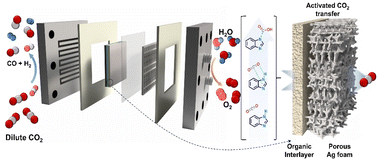
Electrocatalysts for the electrochemical CO2 reduction reaction (CO2RR) have been developed for carbon neutrality by enabling the direct conversion of renewable resources into valuable carbon-based fuels and chemicals. Even electrocatalysts that exhibit high selectivity for CO2RR at high CO2 concentrations often suffer from increased competitive hydrogen production at lower CO2 concentrations, requiring the investigation of catalysts that maintain stable selectivity across a wide concentration range. In this work, we fabricated a highly porous three-dimensional (3D) silver foam on an organic layer-added gas diffusion electrode. The porous 3D Ag foam exhibited the greatest improvement when combined with a benzimidazole organic layer (BI-sf), whose suitable CO2-affinitive interfacial modifier and release facilitated CO2 reduction pathways toward CO production on the Ag surface. These phenomena helped to enhance the partial current density (jCO) and faradaic efficiency (FE) for CO production under diffusion-controlled regions. Compared with Ag nanoparticles (AgNP), the BI-sf electrocatalyst achieved a 4-fold and 2.5-fold increase in maximum jCO with membrane-electrode-assembly (MEA) under 10% and 100% CO2 concentration conditions, respectively. Additionally, when the CO2 concentration decreased within 50–10%, BI-sf maintained relatively higher FE (CO) values compared to when BI was absent, demonstrating the promoting effect of BI under low concentrations of CO2. These findings suggest that adjusting molecular interactions with CO2 is particularly important to achieve high product selectivity in CO2RR under low CO2 concentrations for practical CO2 utilization applications.
 Please wait while we load your content...


