


 PLATFORM UPDATE:


Enhancement of the thermoelectric performance via defect formation and device fabrication for Cu26Ti2(Sb,Ge)6S32 colusite
 *ab
Susumu
Fujii,
c
Pierric
Lemoine,
d
Philipp
Sauerschnig,
e
Michihiro
Ohta,
e
Emmanuel
Guilmeau
f
and
Michitaka
Ohtaki
ab
*ab
Susumu
Fujii,
c
Pierric
Lemoine,
d
Philipp
Sauerschnig,
e
Michihiro
Ohta,
e
Emmanuel
Guilmeau
f
and
Michitaka
Ohtaki
ab
Abstract
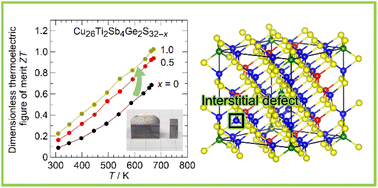
A copper-based multicomponent sulphide, Cu26Ti2(Sb,Ge)6S32 colusite, is a promising thermoelectric material. We investigated the effects of sulphur deficiency on the crystal structure, electronic structure, and thermoelectric properties in the series Cu26Ti2Sb4Ge2S32−x. By combining experiments and ab initio calculations, we found that sulphur deficiency induced the formation of interstitial Cu atoms in the sphalerite-like framework of Cu26Ti2Sb4Ge2S32. This resulted in a decrease in the hole carrier concentration and a susbtantial enhancement of ZT up to unity at 673 K. We also fabricated a power generation device composed of the sulphur-deficient colusite, Ni–Sb-based compounds (interface material), and Ni. The maximum conversion efficiency of the device reached 3.2% with a temperature difference of 266 K.
- This article is part of the themed collection: Thermoelectric energy conversion
 Please wait while we load your content...


