


 PLATFORM UPDATE:


Boosting the syngas production of a SrTiO3 photocathode via plasmonic hot electron injection from an Ag underlayer
 *b
and
Mojtaba
Abdi-Jalebi
*a
*b
and
Mojtaba
Abdi-Jalebi
*a
Abstract
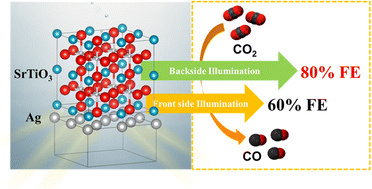
Photoelectrochemical (PEC) CO2 reduction offers a promising pathway for sustainable fuel generation powered by sunlight. However, current PEC systems face two major challenges: inefficient charge separation and limited visible-light absorption in conventional semiconductor photocatalysts. In this study, we addressed these limitations through an innovative material design that integrates plasmonic silver nanostructures with a SrTiO3 perovskite, creating a high-performance and durable hybrid photocathode for CO2 reduction. The hybrid photocathode was fabricated via the spin-coating of a SrTiO3 film and the deposition of a thin plasmonic silver layer—either as an underlayer or an overlayer—using physical vapor deposition (PVD). Notably, the silver underlayer beneath SrTiO3 demonstrated remarkable performance under back illumination. The silver film served dual functions: it extended light absorption into the visible spectrum through the localized surface plasmon resonance (LSPR) and simultaneously suppressed charge recombination. This synergistic effect delivered exceptional CO2 reduction activity, achieving 80% faradaic efficiency for CO production at a low potential of −0.8 V vs. RHE, with a CO generation rate of 12 µmol h−1 mg−1—three times higher than that of pristine SrTiO3. These findings establish plasmonic-perovskite hybrids as a promising platform for solar fuel generation, combining the stability of oxide semiconductors with the optical tunability of metal nanostructures—achieved here by embedding the metal layer beneath the semiconductor. The design principles demonstrated can be extended to other photocatalytic systems for renewable energy applications.
- This article is part of the themed collection: Celebrating International Women’s Day 2026: Women in Journal of Materials Chemistry A
 Please wait while we load your content...


