


 PLATFORM UPDATE:

Magnetic-field-induced vertical alignment of carbon nanotubes in Na3V2(PO4)2F3 with bulk dual-doping for high-rate sodium-ion batteries
 *abcd
*abcd
Abstract
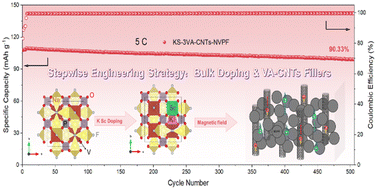
Sodium vanadium fluorophosphate (Na3V2(PO4)2F3, NVPF) as a polyanionic cathode material has attracted considerable interest due to its high operating voltage and robust structural framework. However, its practical application at high rates is severely hindered by intrinsically low electronic conductivity and sluggish ionic diffusion kinetics. This work proposes a stepwise engineering strategy that addresses charge transport limitations from the electrode architecture to the bulk material. Specifically, construct a three-dimensional conductive network of vertically aligned carbon nanotubes (VA-CNTs) within the NVPF cathode via a magnetic-field-assisted technique, combined with K/Sc dual-element bulk doping. It is demonstrated that the VA-CNTs significantly reduce interfacial resistance and provide direct pathways for electronic diffusion, outperforming conventional randomly dispersed CNTs. Furthermore, the co-doping of K and Sc synergistically expands sodium-ion migration channels and optimizes the electronic structure of the material, thereby enhancing intrinsic conductivity. This strategy endows the modified KS-3VA-CNTs-NVPF cathode with remarkable high-rate performance and impressive cycling stability: a capacity retention of 90.33% after 500 cycles at 5 C, significantly surpassing the 67.28% of the unmodified NVPF, and a capacity retention of 75.94% after 1000 cycles at a high rate of 30 C. This work not only offers an effective route for developing high-performance NVPF cathodes, but also presents a universal stepwise engineering strategy that opens a new paradigm for designing other high-rate electrode materials.
 Please wait while we load your content...


