


Initial state of charge controls interfacial kinetics for approaching 100% efficiency in aqueous redox electrolytes

Abstract
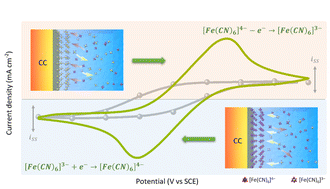
Redox active electrolytes significantly enhance the energy density of aqueous electrochemical energy storage devices (AEESDs), but their coulombic efficiency (CE) often remains limited due to the inadequate optimization of the initial state of charge (ISOC). Here, we employ multi-potential-step measurements (MPSM) combined with potential resolved sensitivity analysis to elucidate how ISOC influences interfacial kinetics in static [Fe(CN)6]3−/[Fe(CN)6]4− electrolytes. Systematic optimization reveals that at 50% ISOC, the system achieves maximum reversibility, attaining a near-perfect CE approaching 100%. Sensitivity analysis indicates minimal response of key electrochemical parameters to ISOC fluctuations in the medium potential region (0–0.4 V), highlighting inherently stable reaction kinetics within this window. In situ Raman spectroscopy further confirms that redox conversion of the [Fe(CN)6]3−/[Fe(CN)6]4− couple is highly reversible in this medium potential regime, whereas spontaneous oxidation and reduction reactions dominate at higher and lower potentials, respectively, significantly diminishing reversibility. Collectively, these kinetic and spectroscopic insights clarify the superior reversibility at 50% ISOC, offering a clear, practical design principle for achieving exceptional efficiency and extended durability in aqueous redox electrolyte energy storage systems.
 Please wait while we load your content...


