


 PLATFORM UPDATE:


Decoupled water splitting technologies: from redox mediators to renewable energy integration
 b
and
Junfang
Cheng
*a
b
and
Junfang
Cheng
*a
Abstract
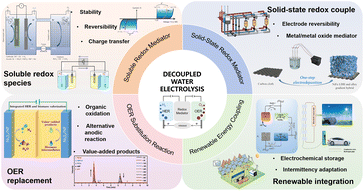
Traditional water electrolysis for hydrogen production faces key challenges including explosion risks from gas crossover particularly at low power despite the spatial separation of hydrogen/oxygen evolution via ion-exchange membranes, high costs associated with membranes and noble metal catalysts, and poor adaptability to renewable energy power fluctuations. In recent years, decoupled water electrolysis technology has emerged as a promising approach, leveraging redox mediators to achieve temporal and spatial separation of hydrogen and oxygen evolution reactions. This innovative design eliminates the need for membranes, thereby addressing safety concerns while enabling compatibility with intermittent renewable power sources. This review systematically traces the evolution progression of decoupled water electrolysis, from early acidic and alkaline mediators to advanced solid-phase redox systems, with a series of mediator systems being established and oxygen evolution substitution reactions being developed. A comprehensive analysis of the underlying mechanisms of redox mediators, alternative oxygen evolution strategies, and system integration with renewable energy sources is provided. Furthermore, the industrialization potential of this technology is evaluated through the assessment of key factors including safety, economic feasibility, and operational adaptability. Finally, critical challenges are identified, including mediator stability, system scalability, and large-scale integration-key issues that must be addressed to bridge the gap between laboratory research and practical deployment. This review offers valuable insights and theoretical guidance for the future advancement of decoupled water electrolysis.
- This article is part of the themed collection: Journal of Materials Chemistry A Recent Review Articles
 Please wait while we load your content...


