


 PLATFORM UPDATE:


Unconventional pharmaceutical drug-templated in situ electrochemical synthesis of redox-active Fe-MOF/MWCNT hybrids for point-of-care voltammetric pH sensing

Abstract
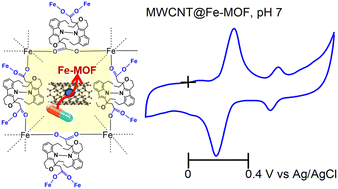
Metal–organic frameworks (MOFs), a class of porous hybrid materials formed by the coordination of organic linkers with transition-metal centres, have attracted considerable interest owing to their tunable physicochemical properties and wide-ranging applications in chemistry, electrochemistry, and biomedicine. In this study, we report for the first time the use of a non-steroidal anti-inflammatory drug (NSAID), etodolac (ETO), as an unconventional molecular template for the in situ electrochemical synthesis of Fe-MOFs on Fe impregnated multi-walled carbon nanotube (MWCNT) and other carbon-nanomaterial-modified electrodes in neutral phosphate buffer (pH 7). The resulting hybrid materials, denoted as MWCNT@Feint-MOF and MWCNT@Feext-MOF, correspond to intrinsic and extrinsic Fe species, respectively. Comprehensive characterisation using FE-SEM, FTIR, Raman spectroscopy, XRD, XPS, EQCM, and cyclic voltammetry confirmed that, under anodic polarisation at +1.0 V (vs. Ag/AgCl), Fe3+ ions were electrochemically stripped from the electrode surface, while ETO was oxidised to a reactive dimeric intermediate, forming ETO–N–N–ETO linkages (dETO). These coupled processes promoted the growth of Fe-MOF architectures on the graphitic domains of carbon nanomaterials, yielding a unique hybrid organic–inorganic framework with excellent conductivity and Nernstian proton-coupled electron-transfer (PCET) redox behaviour. As a proof of concept, a disposable three-in-one screen-printed electrode (SPE) modified with MWCNT@Fe-MOF and integrated with a portable programmable potentiostat enabled a rapid one-drop pH sensing application. The system was successfully validated on various real samples. Overall, this work introduces pharmaceutical drugs as unconventional molecular templates for MOF synthesis, offering a novel strategy for the design of advanced electrochemical redox systems for device development and practical applications.
- This article is part of the themed collection: Journal of Materials Chemistry A HOT Papers
 Please wait while we load your content...


